


Is your process a good candidate for the application of a vision inspection system? We can assist with a feasibility analysis to determine if a vision system is a good fit for your process. Send us a few photos of the conditions from which you wish to differentiate, and we can provide quick examples of programs which will discern acceptable and unacceptable conditions.
Vision is one of the most flexible of inspection methods for small to mid-size manufacturers. One of the considerations we often put in front of our customers is the potential re-use of this hardware in their operation. As the options with optical inspection systems continue to increase it has become more affordable to buy a system with options which are not immediately necessary to provide many opportunities for future utilization. We have helped small manufacturers re-purpose the same systems on numerous occasions. Your system could start on a screw machine, move to a cnc mill, and later to a final inspection area. It could just as easily start on a high speed conveying line, move to an automated inspection area, and finally a quality lab. You may have to change lighting or a lens but those additions add to later flexibility and the likelihood your inspection camera will be used for a very long time. However, if the budget dictates we can always optimize the components to assist you in hitting the price points you desire while satisfying the need at hand.
Check Out Our Articles:
- Five things to consider when integrating robots with machine vision inspection.
- Machine Vision Lighting Techniques
- A New Machine Vision Option
- Process Validation on Automated Inspection Samples
- New Vision Sensors
- Machine Vision Measurements
Robot Integrations Page
If you’d like to send us information about your project, please click here.
Measurements in Silhouette
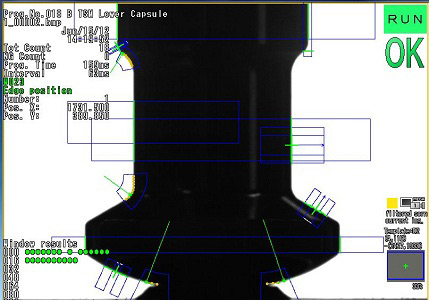
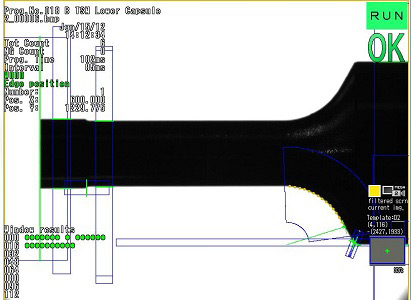
Measuring parts is a very common type of inspection. It can be done without contact, and at high speeds. We frequently measure in the range of ten millionths of an inch but the accuracy and precision of such activities is virtually unlimited. Successful machine vision results are essentially a function of matching the hardware, software, and optics with the constraints generated by the machine vision inspection.
High Precision Measurements in Machine Vision Today the accuracy and precision on vision systems seems virtually unlimited. This particular example provided the following results with little effort.
- Measurement Precision and Accuracy to .000010”
- 30 Measurements and 12 calculated outputs in a cycle time of less than 67 milliseconds
- 45 Separate Programs for Different Parts
Today it’s possible to measure some parts in as little as 4 milliseconds.
Defect Prevention
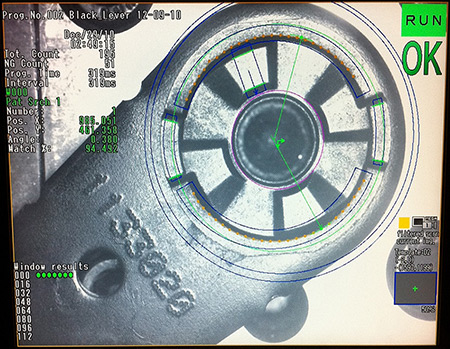
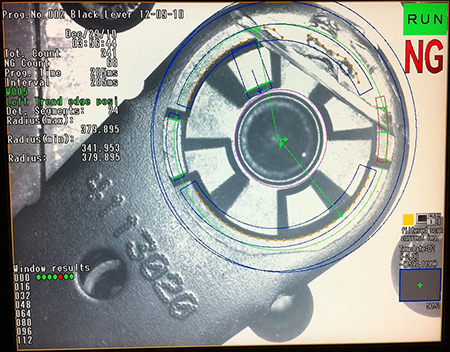
Distinguishing between good parts and bad can be done with a multitude of approaches, from simple pattern searches, blob or stain detection, differentiating by color, custom vision tool application, measurements, and custom programming.
This customer had an existing system that needed programming improvements to achieve their desired system performance. We helped them to add specific vision tools to achieve an optimized result. Do you have an existing system that needs a few programming additions to move to a new level of performance?
Mistake Proofing
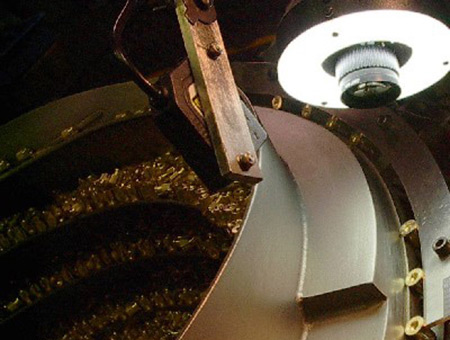
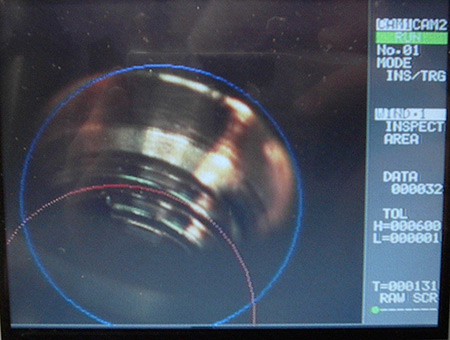
Occasionally parts will escape a screw machine operation where a threading tool has broken. This system finds any parts that move downstream with missing threads and ejects them from the process.
Finding Burrs
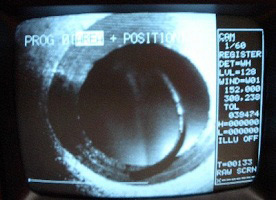
The picture on the right shows an aluminum burr in the bore of a machined part. The burr is only .002” thick. We can assist in finding defects on parts which are sometimes difficult to detect with the human eye.
Assembly Verification
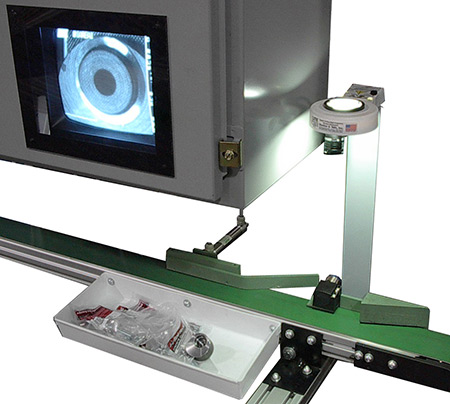
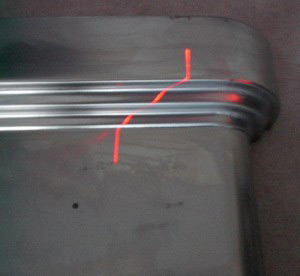
Laser Topography
Pattern Matching
 Pattern matching was one of the first tools developed for vision systems. In its most basic form it is simply comparing and counting pixels against a master file. Pattern matching by itself has probably been responsible for selling more vision systems than any other software feature. It is incredibly simple to set up and demonstrate to a customer. When looking at a couple of sample parts in a quick demonstration it can promote a deceptive confidence in this vision tools ability to solve the problem at hand.Then when a customer integrates a camera in their process and they start looking at hundreds, or thousands of parts the weakness of using this tool exclusively becomes very apparent. There are very specific constraints which must be applied to use such a tool successfully.Clearly pattern matching is an important tool when applied correctly. Used in combination with other vision tools it can be utilized to develop very strong solutions in vision system integration.